Why the Campus to Corporate Transition Fails and What Nobody Tells Freshers

Written by Catalyze
22/10/2026
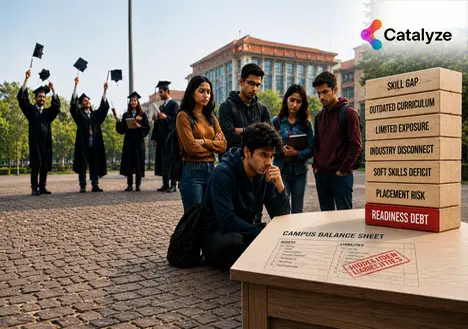
Six months later, nobody is celebrating. One of those students is sitting in a review, being told she "lacks ownership". Another has quietly started applying elsewhere. A third has already left.
None of them failed an exam. They struggled with the campus to corporate transition, the stretch between the offer letter and the first real verdict on their work. Colleges celebrate the start of it and rarely prepare students for what comes next.
The Offer Letter Is Not the Finish Line
Colleges measure placement success at the gate. Packages, offers, percentage placed. Then the file closes.
Employers keep evaluating. They watch how a new graduate learns, communicates, takes responsibility and works with a team. Those first months can shape how recruiters see an institution's preparation for work.
And the numbers are uncomfortable.
Gi Group Holding's September 2026 study of India's entry-level talent found that 49% of surveyed Tier-2 and Tier-3 graduates feel completely unprepared for their first job. In the Tier-1 comparison group, only 6% said the same.
For institutions serving students from similar backgrounds, that raises a hard question. How many of your graduates feel ready for the workplace, beyond the placement interview? If the honest answer is "we don't know", the campus to corporate transition is happening without you.
Knowledge Alone Is Not Enough
Here is the finding that should change how colleges think about readiness.
In the same study, 42% of employers named difficulty applying practical skills as a top reason for unsuccessful interviews. Only 4% pointed to weak academic knowledge.
Academics still matter. But knowing the answer and putting it to work in front of other people are two different skills, and colleges train the first far more than the second.
Picture the topper who explains a concept perfectly in a viva, then freezes when a manager asks, "So what do you recommend?" The knowledge is there. The practice of using it under pressure is not.
That gap shows up at the interview table, and it does not disappear on joining day. It is exactly where the campus to corporate transition gets difficult.
Five Things Nobody Tells Freshers
Some of the hardest challenges faced by freshers have little to do with technical knowledge. They are unwritten rules managers often assume a new joiner already knows.
1. "Look into this" is the entire brief.
College gave a syllabus, a format and a deadline for everything. Work often gives one line. Asking a sharp clarifying question and proposing a next step shows far more ownership than waiting for complete instructions.
2. Silence is not approval.
Professors return marked papers. Managers may say nothing for weeks. Good managers give feedback, but the freshers who ask for it early are rarely surprised at their first review.
3. Being right is not enough.
A correct answer buried in a long, unclear email goes nowhere. Accuracy still matters. Clarity is what helps people act on it.
4. Disagreement will come early.
A teammate who misses a deadline. An unhappy client. A senior who wants it done differently. Many graduates have had little chance to practise professional disagreement, so they go silent or get defensive.
5. Confidence is not the same as readiness.
Freshers are told to "be confident" in interviews. At work, confidence without listening can read as arrogance. One good question often earns more trust than ten minutes of talking.
These are the workplace expectations for freshers that offices run on. Very few of them appear in a college syllabus.
The Question Colleges Avoid
Ask any placement cell how many students got offers. They will have the number in seconds.
Ask how last year's graduates are doing six months into those jobs, and the room usually goes quiet.
That silence is the real gap. Institutions track the offer and lose sight of the person. If your placement report stopped at the gate this year, three additions would change the picture:
- Alumni check-ins at six months. Are graduates still in role, and what surprised them?
- Recruiter feedback beyond hiring. How well are your graduates meeting workplace expectations for freshers once they join?
- Repeat recruiter trends. Which companies return, and which quietly stop coming?
When a recruiter stops coming back, they rarely explain why. These questions help you find out before the gap shows up in next year's numbers.
Over time, those answers also show whether students are leaving with corporate readiness skills or just with a degree and an offer letter.
Why a Lecture Will Not Fix This
The usual answer is a final-semester session on "corporate etiquette". Dress codes, email formats, how to shake hands. Students nod along and forget it by joining day.
Try this with a final-year class. Ask what they would do if a manager rejected their work in front of the whole team. Many have never even pictured it, let alone practised it.
That kind of campus to corporate training treats the problem as manners. It is really about behaviour under pressure, and behaviour changes through practice.
A student cannot learn to handle a vague brief by hearing about one. They have to be handed one, struggle with it and get honest feedback, while the stakes are still low. That is how corporate readiness skills move from a slide into a habit.
How Catalyze Closes the Gap
Catalyze works on the stretch between the offer letter and the first review.
Founder Amneet Kaur Sahdra, an Indian School of Business alumna with 15 years of experience building teams, operations and organisations, started Catalyze after seeing the same pattern repeatedly. People knew enough. They struggled to apply it with confidence at work.
So Catalyze's campus to corporate training is built on practice, not lectures. Students go through workplace simulations, role plays, business scenarios, and mock interviews, with coaching and live feedback. They build communication, emotional intelligence, adaptability, critical thinking, collaboration, and conflict resolution in situations where those skills are tested.
What this gives your institution:
- Preparation for the job, not just the interview. Sessions are designed around the real challenges faced by freshers once they join.
- Evidence you can share. Career-readiness assessments and progress reports show how students are developing.
- A format that fits your campus. From a one-day workshop to a year-long partnership, aligned to your academic calendar and student profile.
Prepare Them for Day 90, Not Just Day One
Placement day will always be worth celebrating. But the offer letter only proves a student got in. The months after show whether they were ready, and by then, it is too late to prepare them.
Institutions that prepare students for the campus to corporate transition, and not just the interview before it, give their graduates a stronger foundation for those first months of professional life.
If you want your next batch ready for the workplace, not just the placement drive, book a consultation with Catalyze.