Campus to Corporate Training in India: A Complete Guide for HR Teams

Written by Catalyze
07/09/2026
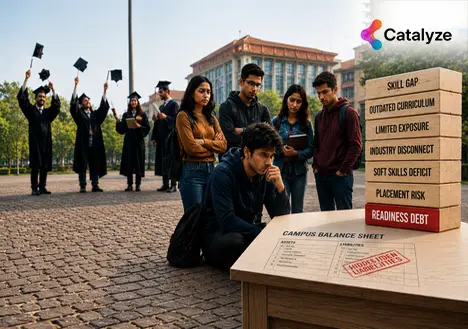
Every campus hiring cycle ends the same way. The offers go out, the cohort joins, induction runs for a week, and within a month the questions start arriving from reporting managers. Why is this person waiting to be told what to do next? Why did that email reach the client without a second read? Why does a capable graduate go quiet in a review? Campus to corporate training is what HR teams reach for at this point, usually after the problem has already cost them a quarter. For any organisation hiring freshers in volume, the difference between a cohort that contributes by month three and one still being supervised by month nine is rarely talent. It is preparation.
The number worth putting in front of your business head
The Mercer Mettl India Graduate Skill Index 2025 assessed more than one million students across over 2,700 campuses in 31 states and union territories. Overall graduate employability came in at 42.6% for 2024, down from 44.3% the year before. That headline figure gets quoted often, and on its own it is not the part HR should be arguing from.
The detail underneath it is. Employability for technical roles actually rose slightly across the same period, from 41.3% to 42.0%. Employability for non-technical roles fell from 48.3% to 43.5% in a single year, and HR associate roles came in lowest of all at 39.9%. The shortfall is not in what graduates know. It is in what they can do with what they know.
That distinction changes the brief entirely. If the gap were technical, more content would close it, and content is cheap to buy. Because the gap sits in communication, judgement, ownership and conduct, content alone changes nothing at all. These are behaviours, and behaviours are built through repetition under conditions that carry consequence, not through a deck delivered on a Friday afternoon.
What actually breaks in the first ninety days
The cost of that gap surfaces in the same five places, cohort after cohort, in almost every organisation hiring freshers at scale. None of them appear on a training needs analysis, because none of them look like skill gaps on paper. They look like ordinary operational friction, absorbed quietly by managers until somebody finally counts it.
- Managers turn into trainers. Time that belongs to delivery goes into explaining how to structure an email, how to run an update call, and how to ask for help before a deadline quietly slips.
- Written work needs review at every stage. Not because the thinking is wrong, but because nobody has ever taught the person to write for an audience that has no time and no patience.
- Silence gets read as agreement. Freshers who have not followed an instruction rarely say so in the room, and the gap only surfaces at submission, when the deadline has already passed.
- Follow-through needs chasing. Ownership is the capability managers name most often when asked what is missing from a new joiner, and it is the hardest one to demand after the fact.
- The cohort thins out. An exit inside the first year erases the cost of sourcing, assessment, offer management, and onboarding, and the replacement hire restarts the same cycle from zero.
None of these are performance problems, which is exactly why performance management does not solve them. They are transition problems, and campus to corporate transition training exists to compress that transition deliberately rather than wait it out and absorb the cost in manager bandwidth and early exits.
The four stages between knowing something and doing it
Readiness is not a switch that flips on the day a cohort finishes a programme. It moves through four stages, and most fresher intakes stall between the second and the third without anybody naming it. That is the reason a session can feel successful in the room and disappear entirely by the second month at the desk.
Stage 1: Gets what to do.
The graduate can explain what good communication or ownership looks like. Most cohorts reach this inside a single session, and most training measurement stops here, which is why post-session feedback scores are consistently high while post-session behaviour change is consistently absent from manager reports.
Stage 2: Able to demonstrate it once.
The graduate performs the behaviour correctly in a workshop, with time to prepare and a facilitator watching. This is where most campus preparation ends. It proves the capability exists. It proves nothing about whether that capability survives contact with a real deadline and a real stakeholder.
Stage 3: Able to repeat it under pressure.
The behaviour holds when the timeline is short, the information is incomplete and somebody senior is visibly unhappy. This stage separates a programme that works from one that merely felt good, and it is reached only through simulation carrying genuine stakes rather than role play with no consequence attached.
Stage 4: Able to do it without supervision.
The manager stops checking. This is the only stage that appears on a profit and loss statement, because it is the point at which a new hire stops consuming senior bandwidth and starts adding capacity to the team. Every stage before it is a cost the business is carrying.
Most campus to corporate training in India is designed for stages one and two, priced for stages one and two, and then judged on stage four. That mismatch explains why so many HR teams have run a programme, seen strong feedback, and watched the same 90-day pattern repeat with the next cohort anyway.
Six behaviours to design for, not six skills to teach
The capabilities that matter are usually written as competencies, which makes them impossible to observe and therefore impossible to measure. Rewritten as behaviours a reporting manager can actually see, they become both trainable and testable. In each case the question is not whether the person has the skill. It is whether they do the thing.
Can they send an update that makes the next decision obvious?
Not whether they communicate well in general. Whether four lines land on a busy stakeholder's screen and that person immediately knows what has happened, what is at risk, and what is being asked of them. Most graduates can write an essay. Very few can write that.
Can they name a problem before the manager finds it?
Ownership is invisible when it is working and expensive when it is not. The observable test is timing. A ready hire flags the slip in week one. An unready hire flags it on the deadline, by which point the only remaining options are bad ones.
Can they arrive with a recommendation rather than a question?
Fifteen years of examinations train a graduate to look for the correct answer and then wait for confirmation. Work rewards a defensible answer, reached quickly, with the reasoning visible enough that a manager can check it in thirty seconds and move on. That reflex has to be rebuilt deliberately.
Can they disagree with someone senior and stay in the room?
Silence in a review is usually read as agreement, and a fresher who has not followed an instruction rarely says so in front of a client or a department head. The gap then surfaces at submission, which is the most expensive possible moment for it to appear.
Can they take direct feedback and visibly change something?
Many capable graduates receive their first piece of unvarnished professional feedback in month two and process it as rejection rather than instruction. What happens in the fortnight afterwards, whether the behaviour visibly shifts or the person quietly withdraws, tends to set the direction of the next two years.
Can they hold a room where everyone is senior to them?
Presence gets dismissed as personality. It is not. It is preparation, pace, eye contact, and a rehearsed way of saying that you do not have the answer yet but will have it by a stated time. Those are habits, and habits can be built.
Every one of these six can be watched, rated by a reporting manager, and tracked across a quarter. That is the difference between a training objective and a business objective, and it is usually the difference that decides whether a corporate readiness program survives its second budget cycle inside your organisation.
How to measure it without relying on feedback forms
Feedback forms are not measurement. A room full of people rating a session nine out of ten tells you the facilitator was engaging and nothing else. If campus to corporate training is going to survive a budget review next year, it needs numbers that a business head already recognises, already tracks, and already cares about.
- Manager supervision hours per new hire across the first quarter, taken from a simple weekly self-report rather than a formal system
- Time to first independent deliverable, meaning work that went out without a manager rewriting it before it left the building
- Rework cycles on written output, counted across the first eight weeks and compared against the previous cohort at the same point
- Twelve-month retention of the cohort, measured against the same milestone in the previous hiring year rather than against a target
- Readiness ratings against the six behaviours above, collected from reporting managers at day 30, day 60 and day 90
Capture the baseline in the cohort before the programme runs, even if the data is rough. Without a baseline, every result afterwards is an opinion, and the conversation with finance next year becomes a conversation about belief rather than evidence. Two weeks of data collection protects the entire investment.
How Catalyze builds behaviour rather than delivering content
Catalyze works as a readiness partner rather than a training vendor, and the difference shows up in the method rather than the marketing. A vendor arrives with a module from a catalogue. Catalyze starts from the friction your managers are already describing and designs backwards from the behaviour you need to see at the desk.
The method runs in six moves. Find the friction by diagnosing where ownership disappears and where energy drains, rather than assuming a template fits. Design for your reality, so the material reflects your culture and your pressures. Put people under real pressure, through simulations that force decisions with consequences attached. Have the hard conversations, so feedback and disagreement are practised safely before they are needed at work. Rebuild the behaviour, so it survives past Friday. Prove the change, openly, before and after.
The formats carry that method into the room. The Pressure Room is a live business simulation against the clock, which is where stage three of the readiness progression actually gets built. Signal and Noise is a high-stakes communication challenge where clarity wins and assumptions cost, in real time. Real Talk creates a structured space for the feedback and disagreement most cohorts avoid. The Debrief converts a memorable day into changed behaviour with actions the group owns going forward.
The question worth asking before the next cohort joins
Campus hiring is not going to get easier. Cohorts will grow, joining timelines will compress, and managers will have less room to absorb the shortfall than they do today. An academia industry gap bridging program run by the college gets a cohort to stage two. Getting them to stage four is work only the employer can do, and it is cheaper to do deliberately than by accident.
If your last cohort took longer to become productive than it should have, the useful question is not who underperformed. It is where the time actually went, which managers absorbed it, and what that cost in delivery. That question is far better asked now than three months after the next batch has already joined.
Map your first 90-day readiness gap with Catalyze. Book a consultation to identify where your managers are losing time, where new hires are losing independence, and which behaviours need to change before the next cohort arrives.