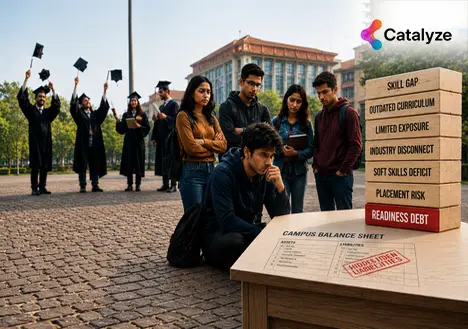
Readiness Debt: The Invisible Liability Sitting on Every Campus Balance Sheet

Written by Catalyze
24/08/2026
Here is a paradox that should keep every dean and placement head awake at night.
Employer hiring intent in India jumped from 29% to 40% for FY 2026-27, according to the India Skills Report 2026. Companies want more freshers than they have wanted in years. Yet over the same period, the Mercer Mettl India Graduate Skill Index shows graduate employability actually fell, from 44.3% in 2023 to 42.6% in 2025.
Demand went up. Readiness went down. Both at the same time.
This is not a job problem. It is not even a skills problem in the way most institutions define skills. It is something quieter and more structural. At Catalyze, after 14 years on the hiring side of the table across companies like Future Group, Skechers, and Outsized, we have given it a name: readiness debt.
What Is Readiness Debt?
Software engineers have a phrase for shortcuts taken today that must be repaid with interest tomorrow: technical debt. Skip the proper fix now, and the codebase silently accumulates a liability that eventually slows everything down.
Campuses accumulate the same kind of debt, just with people instead of code.
Every semester an institution defers the human layer of education- the communication, presence, ownership, and workplace behaviour that hiring rooms actually evaluate- it books a small, invisible liability. No line item records it. No audit flags it. The syllabus is complete, the exams are conducted, the degree is awarded. On paper, everything balances.
Then placement season arrives, and the debt comes due. All at once. With interest.
Students who were never taught how to hold a room walk into group discussions. Students who have never written a professional email face a recruiter's inbox. Students who confuse marks with readiness sit across from an interviewer who decided within five minutes. The Cengage Group 2025 Graduate Employability Report found that half of educators dedicate 20% or less of their curriculum to workforce skills. That remaining 80% is where readiness debt compounds, quietly, semester after semester.
The Ledger: Where the Debt Accrues
Entry One: The Curriculum Gap
The India Skills Report 2026, published by ETS with CII, AICTE, AIU, and Taggd, delivered good news and buried the bad news in the same paragraph. Employability rose to 56.35%, but the report explicitly flags persistent deficits in communication, teamwork, problem-solving, and critical thinking, even among technically competent graduates. The technical layer of Indian education is improving. The human layer is standing still. That widening spread between the two is accruing debt.
Entry Two: The Perception Gap
Debt is most dangerous when the borrower does not know it exists. Research published by NACE in 2025 found a gap of nearly 30% between how proficient graduates believe they are in leadership and professionalism and how proficient employers actually find them. Students genuinely think they are ready. Their institutions, by staying silent, confirm that belief. Nobody discovers the shortfall until the interview, which is the single most expensive place to discover it.
Entry Three: The Demand Signal Nobody Answered
Students themselves are asking for repayment. The India Skills Report 2026 found that 92.8% of students actively seek internships and hands-on exposure. The appetite exists. The structure does not. When an institution cannot supply structured readiness, students improvise with YouTube videos and last-minute mock interviews, which is the equivalent of paying off a loan with another loan.
Who Pays the Interest?
Students Pay First
They pay in rejected applications and shaken confidence. ManpowerGroup's 2025 research found that 80% of Indian employers struggle to find the skilled talent they need, above the global average of 74%. Read that carefully: the jobs exist, the employers are searching, and graduates are still not clearing the bar. Every rejection is an interest payment on debt the student never knowingly took on.
Employers Pay Next, and They Are Keeping Receipts
India's largest IT companies have effectively built parallel universities. As Forbes India noted in 2025, both TCS and Infosys operate some of the world's largest corporate training centres, largely to make fresh graduates deployable. When industry has to construct remedial infrastructure at that scale, it is publicly pricing the readiness debt that campuses transferred to them. And employers respond the way any creditor does: they tighten lending. That is exactly what falling fresher intake numbers reflect.
The Institution Pays Last, and Pays the Most
Here is the compounding effect institutions underestimate. Recruiters remember campuses the way lenders remember defaulters. A batch that underperforms in interviews does not just hurt this year's placement percentage. It quietly reprised the institution's brand for the next three recruiting cycles. Placement statistics are a lagging indicator. Readiness is the leading one. Institutions that manage only the lagging number are reading last year's balance sheet and calling it a strategy.
The Repayment Plan: How Institutions Can Clear the Debt
The encouraging truth about readiness debt is that, unlike financial debt, it can be repaid fast, and the interest works in reverse once you start. This is precisely the work Catalyze does as a readiness partner to India's education institutions, and here is what repayment looks like in practice, whether an institution builds it internally or builds it with us.
Audit it before you address it.
No institution would run its finances without an audit, yet almost none audits readiness. A structured pre-assessment of a batch, covering communication, interview behaviour, and professional presence, converts an invisible liability into a visible, measurable number that leadership can act on.
Move readiness inside the timetable.
As long as readiness lives in optional weekend workshops, it will be treated the way students treat everything optional. The institutions closing the gap are embedding it into scheduled academic hours, in cohort sizes small enough for practice rather than lecture. The WEF Future of Jobs Report 2025 places analytical thinking and human skills at the top of the global skills agenda; content that is important cannot be extracurricular.
Bring the hiring room into the classroom.
Faculty are experts in their disciplines, not in what recruiters decide in the first five minutes. Repayment accelerates when institutions partner with people who have actually sat on the hiring side of the table, so students rehearse against real evaluation criteria, not assumed ones. This is the foundation Catalyze is built on: credibility earned inside the hiring room, not theory borrowed from a textbook.
Measure the delta, not the attendance.
A session happening is not an outcome. A readiness score that moved between a pre-assessment and a post-assessment is. Institutions that can show recruiters measurable improvement in a batch are doing something more powerful than marketing: they are publishing evidence. It is why every readiness engagement Catalyze designs is bookended by assessment, because a number that moved is the only proof that matters.
Start before final year. Debt repaid early costs the least. Confidence and communication built in the second year compound just like the deficits do, only in the institution's favour this time.
The Bottom Line
The 2025 and 2026 data has settled one question and opened another. Employability is no longer only a student's problem or an employer's complaint. It is an institutional liability that accrues silently and comes due publicly, every single placement season.
The institutions that will lead the next decade are not the ones with the best brochures. They are the ones that treat readiness the way a CFO treats debt: named, measured, scheduled for repayment, and reviewed every quarter. The paradox of rising demand and falling readiness is not a threat to those institutions. It is the single biggest competitive opening in Indian higher education right now.
If your institution does not yet have an answer, that is exactly the conversation Catalyze exists to have. Because our conviction is simple: students should leave campus not just academically qualified, but professionally prepared.