How Does Campus-to-Corporate Training Help Freshers Transition Into the Workplace?

Written by Catalyze
09/09/2026
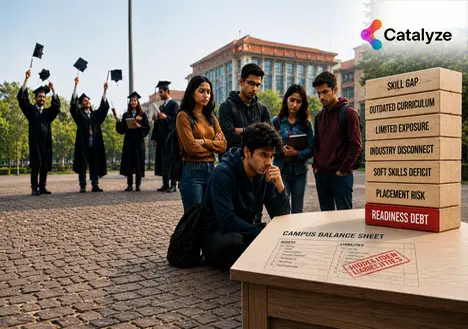
The first ninety days of a job feel nothing like the last four years of college. Deadlines don't come with reminders. Feedback isn't graded on a curve. And nobody tells a new hire exactly what to do next, they're expected to figure it out. This is the exact gap that campus to corporate transition training is designed to close, and it's why so many freshers who did well academically still struggle once they're actually sitting at a desk with real responsibility.
Why the Gap Between Campus and Corporate Life Is So Wide
The numbers back this up more than most people expect. According to the India Skills Report 2026, released by ETS and Wheebox in collaboration with CII, AICTE, and AIU, national graduate employability has climbed to 56.35%, up from 54.81% the year before. That sounds like progress, and it is. But it also means close to half of India's graduates are still not considered fully job-ready by employers, even after finishing their degrees.
The government's own Periodic Labour Force Survey tells a sharper version of the same story. Graduate unemployment in India stands at 11.2%, more than three times the national unemployment rate. That gap doesn't come from a shortage of degrees. It comes from a shortage of the behaviours a workplace actually runs on.
The Skills Nobody Grades You On
Nobody fails a student for hesitating in a meeting or struggling to disagree with a senior colleague respectfully. But these are exactly the moments that shape how a fresher is perceived in their first few months at work. TeamLease EdTech's Career Outlook Report found that when Indian employers were asked what they actually look for in freshers, the answers centered on negotiation and persuasion, cognitive flexibility, curiosity, and emotional intelligence, not just marks or certifications. The absence of a grade for these skills in college doesn't mean the absence of a test for them at work.
What Campus to Corporate Training Actually Involves
Good campus to corporate training isn't a one-day orientation about dress codes and email etiquette. It's built around the actual behaviours a workplace expects and the moments where freshers usually stumble.
Communication That Works Beyond the Classroom
Presenting an assignment to a professor is different from presenting an update to a manager who has five other priorities competing for attention. Training that focuses on real workplace communication, not classroom presentation skills, prepares freshers for the kind of conversations they'll actually be having.
Practising Real Scenarios, Not Just Theory
The most useful programmes put freshers through situations they'll genuinely face: pushing back on an unclear instruction, asking for help without appearing incapable, managing a disagreement with a peer. Practising this before it happens for real removes a lot of the panic when it eventually does.
How Campus to Corporate Transition Training Helps Freshers Adjust Faster
This is where the training earns its purpose. It isn't about making freshers look polished. It's about making the actual adjustment period shorter and less stressful, and closing the same gap the India Skills Report keeps flagging year after year.
Building Confidence Before Day One
A fresher who has already practised handling an unclear brief or a difficult conversation walks into their first week with less anxiety about the unknown. They've been there before, just in a lower-stakes setting.
Learning Judgement, Not Just Etiquette
Amneet Kaur Sahdra, Founder of Catalyze, has written about how companies are rethinking what they actually look for in freshers. In her piece on entry-level hiring, she points out that many organisations have started prioritising how quickly someone learns and adapts over what they've already done, since a fresher, by definition, hasn't done much yet. That shift matters here too. Campus to corporate transition training that focuses on building judgement and adaptability prepares freshers for what employers are genuinely evaluating, not just what looks good on a resume.
Why Corporate Training for Freshers Needs to Start Before the Offer Letter
Waiting until a fresher has joined a company to teach them workplace behaviour is often too late. The first few weeks are usually when impressions form, and they're hard to reverse.
Good corporate training for freshers starts while they're still students, so the adjustment happens gradually instead of all at once on day one. This also means freshers arrive at their first job already familiar with basic workplace rhythms: how to structure an update, how to ask for feedback, how to manage their own time without a syllabus dictating it for them. Given that TeamLease's data shows curiosity and continual learning are now among the top traits employers screen for, students who've had time to practise these habits before graduation start their careers with a real advantage over those who haven't.
Why Catalyze Takes a Different Approach
Most training providers treat this as a short pre-placement formality. Catalyze was built around a longer view of readiness.
Founded by Amneet Kaur Sahdra, an alumna of the Indian School of Business with 15 years of experience building teams and organisations, Catalyze works with institutions to prepare students for the realities of their first job, not just the interview that gets them there. The intent behind each programme is to help students build the communication, confidence, and judgement they'll actually need once they're sitting across from a manager instead of a professor.
The Bottom Line
The gap between campus and corporate life isn't about intelligence or effort. It's about exposure to situations college simply doesn't create, and the national data on graduate employability keeps confirming just how wide that gap still is. Campus to corporate transition training that's built well gives freshers that exposure early, so their first ninety days feel like a continuation of what they've already practised rather than a crash course learned under pressure. That's the kind of transition Catalyze is designed to support, well before a fresher's first day at work.
Quick Summary
- India's graduate employability stands at 56.35%, while graduate unemployment is over three times the national rate, showing a real and measurable readiness gap
- The gap between college and corporate life is behavioural, not academic
- Employers increasingly screen freshers for adaptability, curiosity, and emotional intelligence over marks alone
- Good campus to corporate training focuses on real workplace scenarios, not generic etiquette sessions
- Training that starts before the offer letter makes the actual transition smoother
- Catalyze's approach is built around ongoing readiness, not a one-time workshop