Workplace Readiness vs Soft Skills Training: What Do Graduates Actually Need?

Written by Catalyze
15/09/2026
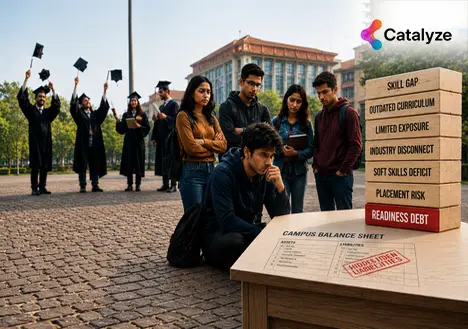
Ask five different people what "soft skills training" means and you will likely get five different answers. Some picture a personality workshop. Others picture a one-day session on email etiquette. Meanwhile, the soft skills training India market has grown into a genuinely large industry. According to IMARC Group, it reached USD 793.8 million in 2025 and is projected to reach USD 1.84 billion by 2034. But growth in the market does not automatically mean graduates are getting what they actually need to survive their first year at work. That is the real question this piece is trying to answer.
Why This Debate Even Exists
Soft skills training and workplace readiness sound similar enough to be used interchangeably. They are not the same thing, and the difference matters more than most students realise until they are already on the job.
Two Different Promises
Soft skills training usually promises to build individual traits, communication, confidence, teamwork. Workplace readiness promises something broader, the ability to actually apply those traits inside a real job, with real deadlines and real people who are not grading on a curve. One builds the ingredients. The other teaches you how to cook with them.
What Soft Skills Training India Actually Delivers
There is real value here, and it would be unfair to dismiss it. Soft skills training India programmes can genuinely improve how someone communicates, listens, and presents themselves.
The Skills It Is Built to Teach
Typical modules cover communication, body language, group discussions, and basic interview preparation. For a student who has never had to speak in front of a panel or structure an argument on the spot, this training closes a real and immediate gap.
Where It Falls Short on Its Own
The limitation shows up once the student is actually hired. Knowing how to speak confidently in a mock interview is not the same as knowing how to push back on an unreasonable deadline, admit a mistake to a manager, or navigate a disagreement with a colleague twice your age. These are workplace situations, not interview situations, and a conventional soft-skills workshop may not give students enough opportunity to practise them.
What a Workplace Readiness Program for Graduates Adds
This is where the second half of the equation comes in, and why the distinction is worth making in the first place.
Practising the Job, Not Just the Traits
A well-designed workplace readiness program for graduates puts students through situations they will actually face at work: an unclear brief, a tense team conversation, a deadline that suddenly moves up. That can mean handling an unclear brief, asking a manager for clarification, giving and receiving feedback, prioritising competing tasks, speaking up in a meeting, or taking ownership when something goes wrong. The goal is not to make someone sound impressive. It is to make sure they do not freeze the first time something does not go according to plan.
What Employers Are Actually Watching For
Amneet Kaur Sahdra, Founder of Catalyze, has made a similar argument in her recent piece on rethinking entry-level hiring. Her argument is that entry-level hiring should place less weight on what a candidate has already done and more on how quickly they learn and how they behave when they don't know the answer. That is not something a communication workshop alone can teach. It requires practice under conditions that resemble the real thing, which is exactly what a workplace readiness program for graduates is built to provide.
Where Professional Skills Training for College Students Bridges the Gap
The most effective approach does not choose one over the other. It combines them.
Building Both Halves Together
Professional skills training for college students works best when it blends the communication and confidence building of traditional soft skills work with the situational practice of workplace readiness. A student who can speak clearly and also knows how to handle an ambiguous instruction is genuinely prepared, not just polished.
Timing Changes Everything
The earlier this training starts, the more it compounds. Professional skills training for college students delivered months before placements gives enough time for actual behaviour change, not just a temporary boost in confidence right before an interview that fades within the first difficult week at work.
Catalyze Was Built for the Gap in Between
Most conversations about student training eventually split into two camps, the ones who swear by soft skills workshops and the ones who insist only real workplace exposure matters. Catalyze exists because both camps are half right, and neither is complete on its own.
Amneet Kaur Sahdra founded Catalyze after seeing this gap repeatedly across her career, capable people with knowledge and technical competence who still needed greater exposure to how the workplace actually works. That observation shaped how Catalyze approaches student readiness, not as a single workshop or a single trait to fix, but as a combined skill set built through repeated, realistic practice over time.
Here Is the Honest Answer
If you were hoping for a clean winner between soft skills training and workplace readiness, there is not one. Graduates need both, built together, not delivered as two separate boxes to check before placement season. Soft skills training India continues to grow because the demand is real, but demand alone does not guarantee depth. The programmes that actually prepare students are the ones that go further than confidence and presentation, into judgement, adaptability, and the ability to handle a workday that does not follow a script. That is the standard Catalyze is built around: helping institutions move beyond one-off soft-skills sessions towards sustained workplace readiness.