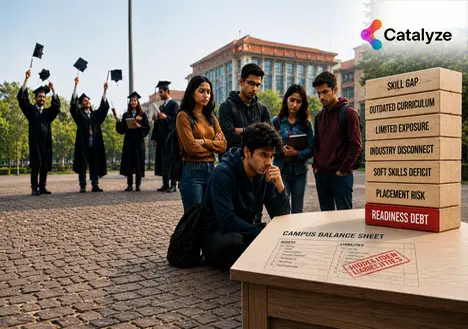
Why Campus Placement Training Fails When It Starts in the Final Semester

Written by Catalyze
04/11/2026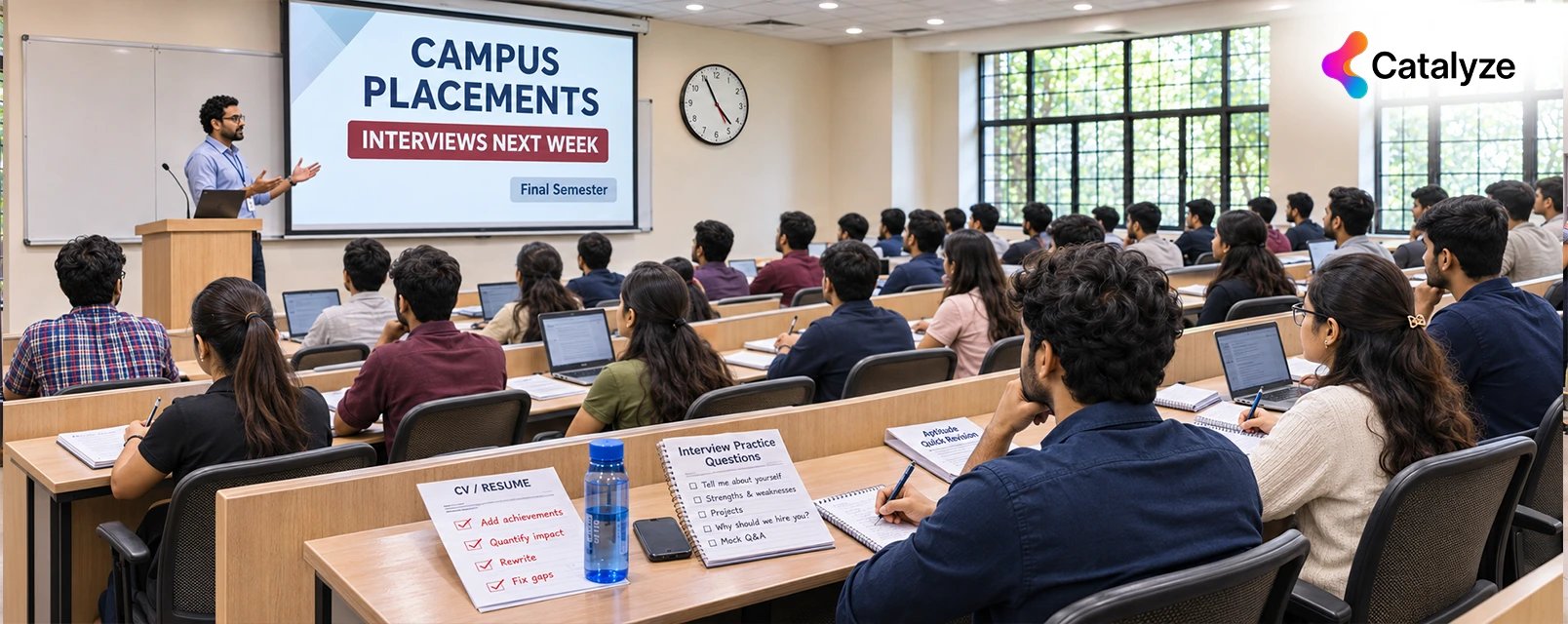
On many campuses, the plan looks the same. The final semester opens, the placement cell books the auditorium, and a trainer arrives with three days of slides on body language, CV tips and "how to crack the HR round".
Students take notes. Attendance looks good. The photos make the newsletter.
Then the drives begin. The same students freeze in the group discussion, ramble in the interview and go silent when a recruiter asks for a real example. The training didn't fail because it was bad. It failed because it was late.
A placement training program for college students works a lot like fitness: you cannot cram it into the weeks before the test. Here is why the final-semester model breaks, what recruiters are checking for in 2026, and what a better timeline looks like for your campus.
The final-semester crash course feels productive. That is the problem
Late training has a convincing surface. Sessions run, attendance is logged and feedback forms come back positive. Students say they feel more confident.
But confidence after a session is not performance under pressure. Learning research has a clear view on this. In a major review published in Psychological Science in the Public Interest, John Dunlosky and colleagues rated distributed practice, meaning learning spread out over time, as one of the two most effective techniques they examined. Packing learning into a short burst tends to produce weaker long-term results, even when it feels efficient.
Communication, composure and teamwork work the same way. They are habits, and habits form through repetition with feedback, not through one intense exposure. That is why a placement training program for college students that begins in the final semester can look busy and still change very little.
Three reasons the late start breaks
1. There is no room to fail safely
Skills grow when students try, get it wrong, hear feedback and try again. In the final semester, every mock interview sits a few weeks away from a real one. Students play safe, and playing safe teaches very little. Effective soft skills training for college students needs early, low-stakes rounds where a bad answer costs nothing.
2. Students arrive with no stories to tell
Recruiters increasingly ask for evidence: a conflict you handled, a project that went wrong, a time you changed someone's mind. Shantanu Rooj, founder and CEO of TeamLease EdTech, framed the 2026 divide as one between candidates who can demonstrate applied skills and those who cannot.
A student who starts preparing in the final semester may have the right answers memorised, but few real experiences behind them. Interview skills training for students works best when there is something to train on: years of projects, roles and setbacks to draw from.
3. The final semester is already full
Final-year students are juggling projects, exams, internships and drive schedules. Training squeezed into that calendar competes with everything else. Attendance stays high because it is compulsory. Attention does not.
What recruiters are checking for in 2026
Demand for freshers is real. TeamLease EdTech's Career Outlook Report for July to December 2026, based on a survey of 1,097 companies, puts fresher hiring intent at 75%, up from 73% in the first half of the year.
The bar is rising with it. Rooj described the shift as less about how many freshers get hired and more about which ones. The Economic Survey 2025-26 makes a similar point at national level, calling for learning to be judged by outcomes and real skills rather than years of study or course completion.
For colleges, the takeaway is direct. Employability skills training for college students now has to produce visible behaviour a recruiter can test, not a certificate a student can show.
The question few placement committees ask
Why does placement training start in the final semester on so many campuses?
Part of the answer is practical. Final-year batches are motivated, and the deadline is in sight. Part of it is less comfortable. A final-semester workshop is easy to schedule, easy to photograph and easy to report. A multi-year plan of soft skills training for college students is harder to run and harder to show in a single report.
If your placement results depend on what happens in the last few months, the training is serving the calendar, not the students.
What a three-year runway looks like
| Stage | Focus | What students practise | What the college learns |
| First year | Communication basics | Speaking in small groups, listening, giving and taking feedback | Who stays quiet, who dominates, who is ready to grow |
| Second year | Collaboration and conflict | Group projects, team challenges, peer reviews | How students behave when work gets hard |
| Pre-final year | Presence under pressure | Group discussions, role plays, internship preparation, first mock interviews | Real gaps, while there is still time to close them |
| Final year | Polish and performance | Company-specific preparation, final mock rounds | Students refining habits, not learning them for the first time |
For four-year programmes, stretch the same arc across the extra year.
Spread this way, employability skills training for college students builds evidence term by term, and the final semester becomes the last lap instead of the starting line. Interview skills training for students, at that point, is about sharpening, not rescuing.
Already deep into this placement season? Use it to plan next year's pre-final batch now, so their preparation starts on time. Talk to Catalyze
Where Catalyze fits in
Catalyze works with colleges as an extension of the placement ecosystem rather than as another training vendor. In practice, that means building a placement training program for college students around your academic calendar instead of squeezing it into the final term.
What your institution gets:
- Flexible commitment: a one-day workshop, a semester-long programme or a year-long campus-to-corporate partnership
- A journey built around you: sessions designed around your academic calendar, student profile and placement goals
- Practice, not lectures: mock interviews, workplace simulations, role plays, business scenarios, coaching and live feedback
- Progress you can show: career-readiness assessments and progress reports built into every programme
- The skills recruiters probe: communication, emotional intelligence, adaptability, critical thinking, collaboration and conflict resolution
That last point matters for the timeline argument. When readiness is assessed at the start and tracked through the year, gaps show up while there is still time to work on them.
Start earlier, not harder
Final-semester training isn't useless. It is simply being asked to do three years of work in three months. Move the start date, and the same effort produces students who walk into drives with habits, examples, and composure already in place.
If your next placement training program for college students still begins in the final semester, this is the moment to plan the version that starts earlier.
Share your batch sizes, academic calendar, and placement goals with Catalyze, and the team will help you map a programme across the years. Book a consultation with Catalyze.