What Recruiters Look for in Campus Placements in 2026 (It Is Not What Colleges Think)

Written by Catalyze
21/10/2026
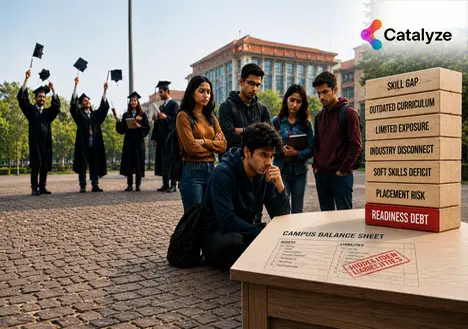
Many institutions believe recruiters have already switched to skills-first hiring, and that a good score plus a certificate shows a student is ready. Recruiters see it differently.
HirePro's State of College Hiring in India 2026 report found that 96% of colleges believe employers have embraced skills-first hiring, while only 21% of corporates say they have fully moved beyond CGPA. And while 68% of students believe they are job-ready on Day 1, just 9% of employers agree.
So marks still count, and so do tests. What colleges miss is that recruiters also want evidence that a student can apply what they know. That evidence is where campus placement skills are really judged.
Round One, the Shortlist
Colleges are right that CGPA matters. The same HirePro report found 51% of corporates still let it influence hiring decisions.
What colleges underestimate is the rest of the resume. Once a student clears the cut-off, the resume has to give the panel something to ask about. This is the first place campus placement skills start to show, long before anyone speaks.
"Completed a summer internship at a logistics firm" gives them nothing. "Rebuilt the dispatch tracker for a 12-person team" starts a conversation. Same internship, a very different chance of being remembered.
Round Two, the Online Test
Aptitude and technical assessments are not losing importance. HirePro's October 2026 findings show companies increasingly using assessments as core selection criteria, not just as filters.
What has changed is how much recruiters trust a score on its own. HirePro reported that 45% of the assessments it ran in FY26 were flagged for integrity concerns, with AI-assisted cheating up 50% in a year.
A flag is not proof of cheating. It does give employers good reason to check that a candidate can show the same ability without help.
The AI certificate adds to the confusion. Here, the campus recruitment trends 2026 data points one way. HirePro found 85% of employers prefer graduates with GenAI skills, yet only 12% make GenAI proficiency mandatory, because many would rather teach the tools after joining.
A certificate tells a recruiter what a student studied. It does not show how that student thinks when the answer is not obvious.
Round Three, the Group Discussion
Not every company runs a GD. Where one is used, it often exposes a gap colleges do not see coming.
Students are coached to enter early, speak often and sound confident. Panels are usually watching for something quieter.
Picture two candidates. The first has a 9.1 CGPA. She opens with a statistic she memorised that morning and repeats it louder when someone challenges her. The second has a 7.4. He builds on another speaker's point, adds an example from his internship and brings a silent participant into the conversation.
The second candidate gives the panel stronger evidence of listening, collaboration and thoughtful communication, even with the lower CGPA. These are the skills recruiters look for in freshers during a GD, and they are seldom built deliberately on campus.
Round Four, the Interview
Technical questions and role fit remain central here. Alongside them, recruiters are checking something colleges rarely prepare students for.
Aon's Campus Study Report 2026-27, based on inputs from over 220 organisations, found that 90% assess culture alignment during hiring. That covers values, behaviour, teamwork, adaptability and communication style. 82% also monitor early attrition.
Aon's findings add a clear signal to the campus recruitment trends 2026 picture. Panels want to know whether a fresher will settle in and work well with others, not only whether they can answer the technical round.
That is why "Tell me about a time you disagreed with a teammate" matters. A rehearsed answer gets through the first question. The follow-up, "What would you do differently now?", needs real reflection.
So, What Do Recruiters Actually Want?
Across the four rounds, the pattern holds. Recruiters value marks, test scores and technical ability. Beyond those, the skills recruiters look for in freshers come down to whether a student can:
- Communicate clearly under pressure
- Read people in a discussion or an interview
- Adapt when a question changes direction
- Think through a problem without notes
- Work with others and handle disagreement calmly
None of these replaces a strong academic record. Each one shows a recruiter what that record looks like in practice. These are also the employability skills for students that help freshers settle and grow after joining.
What This Means for Your Placement Cell
On many campuses, preparation hours go mostly to the test, while the campus placement skills tested in GDs and interviews get the last few weeks.
A few changes can rebalance that.
- Start earlier. A campus placement preparation 2026 plan that begins in the final semester begins after habits are already set.
- Practise more than once. Mock GDs and interviews work when they come with honest feedback and repetition.
- Turn experience into stories. Projects and internships should become examples students can explain and defend.
- Track where students drop. Review your campus placement preparation 2026 results round by round. If many students fall at the GD or interview, the gap is not only technical.
Where Catalyze Fits
Catalyze works with institutions on the part of placement readiness that is hardest to build in a classroom. Founder Amneet Kaur Sahdra, an Indian School of Business alumna with 15 years of experience building teams and organisations, started it after seeing how often young people knew enough but struggled to apply it with confidence at work.
Students practise communication, emotional intelligence, adaptability, critical thinking, collaboration and conflict resolution through mock interviews, workplace simulations, role plays and business scenarios, with live feedback and coaching.
For an institution, that means:
- Learning aligned to your academic calendar and student profile, from a one-day workshop to a year-long partnership
- Career-readiness assessments and progress reports that show how students are developing
- Repeated practice in the settings recruiters use, so students can show the abilities behind their marks
- Making employability skills for students part of the plan, not something left to chance
The Gap Colleges Can Close
Recruiters are not asking colleges to choose between academics and skills. They want both, and they want to see the second one in action. Institutions that give students repeated chances to practise interviews, discussions and workplace scenarios can help them demonstrate the campus placement skills recruiters increasingly value.
If your institution wants its students ready for every round of the drive, book a consultation with Catalyze and plan your next placement season around what recruiters actually look for.