What Happens After the Placement Offer, and Why Freshers Still Struggle in Month One

Written by Catalyze
27/10/2026
Quick answer: After the placement offer, many freshers wait weeks or even months to join, then face a first month that tests skills college rarely practised: reading expectations, asking for help, workplace communication, taking feedback, managing priorities, and building working relationships. Company onboarding mainly covers systems, policies and the role. Post-placement training for freshers uses the time between offer and joining to rehearse these situations.
In March, a final-year student receives the message she has been waiting for: Selected.
Her family celebrates. The placement cell records another successful offer. Five months later, she joins her first company.
By week three, she is struggling to prioritise tasks, unsure when to ask for help and finding it difficult to respond to feedback. She knows her subject. She cleared the interview. But nobody prepared her for the everyday expectations of a workplace.
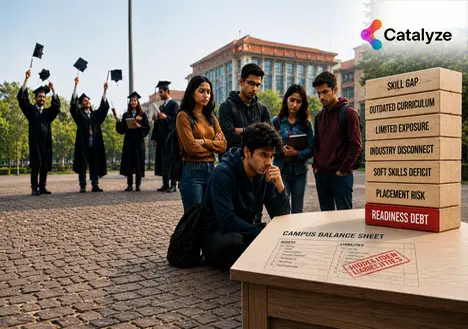
Getting placed and being workplace-ready are two different milestones.
This guide explains what happens after the offer, the challenges faced by new employees in their first month at a new job, and how post-placement training for freshers helps close the gap.
What Happens After the Placement Offer?
For many students, the offer is followed by a wait. Final exams, convocation and paperwork come first, and joining dates can move. In January 2026, Outlook Business reported a complaint filed by the employees’ body NITES, alleging that more than 250 freshers who received letters of intent from Wipro around May 2025 had still not been onboarded. The Unstop Talent Report 2026 found that 17% of undergraduate students faced delayed or rescinded offers.
Delayed onboarding creates uncertainty for graduates, especially when joining dates remain unclear. But even when companies follow their planned schedules, students may have several weeks between receiving an offer and starting work. For colleges, that planned transition period is an opportunity to extend placement support beyond interview preparation and help students practise the behaviours their first job will demand.
What Challenges Do Freshers Face in the First Month at a New Job?
The challenges faced by new employees in month one are rarely technical. They are about people, expectations, and pace. Six come up repeatedly.
1. Unclear expectations
What happens. The fresher finishes a task, then learns it was not what the manager wanted.
What it costs. Rework, and a manager who starts checking everything twice.
2. Hesitation to ask questions
What happens. Staying stuck for two days to avoid looking incompetent.
What it costs. A missed deadline that a two-minute question would have saved.
3. Workplace communication
What happens. A casual reply to a senior, or a long email where three lines would do.
What it costs. Messages that get ignored, misread or escalated.
4. Receiving feedback
What happens. Correction is taken as criticism, and the fresher goes quiet.
What it costs. Fewer chances to improve, because people stop offering feedback.
5. Managing priorities
What happens. Three tasks from three people, and no sense of which comes first.
What it costs. The urgent task slips while the easy one gets done.
6. Building working relationships
What happens. Weeks of eating lunch alone, unsure how to approach seniors.
What it costs. Nobody to ask, which makes every other challenge harder.
These struggles can last. In Robert Walters research reported in July 2026, covering professionals in the UAE, 21% of junior employees said it took more than six months to feel fully effective in their role, and 28% said training and role clarity were lacking during onboarding.
Why Pre-Joining Preparation Still Matters When Companies Offer Onboarding
Company onboarding introduces employees to organisational systems, policies, tools and role-specific responsibilities. Some employers also provide mentoring and behavioural training, but the depth of that support varies.
Freshers may still struggle with everyday situations such as clarifying expectations, managing competing priorities or responding to constructive feedback. These onboarding skills for freshers are easier to learn before the pressure of a real role begins.
Preparing students before joining does not replace employer onboarding.
It helps them enter that process with greater awareness, confidence, and practical experience.
What Should Post-Placement Training for Freshers Cover?
Month-one challenge | What the training rehearses |
| Unclear expectations | Repeating a brief back and confirming deadlines before starting |
| Hesitation to ask questions | Knowing when to ask for help, and explaining what has already been tried |
| Workplace communication | Adapting emails, updates and chat messages to the audience and situation |
| Receiving feedback | Asking clarifying questions and turning feedback into a next step |
| Managing priorities | Comparing deadlines, clarifying urgency and flagging delays early |
| Building working relationships | Introductions, collaboration and respectful disagreement |
Good workplace readiness training practises these in realistic situations with feedback, rather than explaining them on slides. Onboarding skills for freshers stick when students have tried them, got them wrong once in a safe room, and tried again.
When Should Colleges Start Post-Placement Training?
The ideal time is after students receive their placement offers but before they join their employers. Instead of one long session, colleges can schedule shorter, practical workshops across the weeks available. An example sequence a college could use:
1. Session 1. Understanding workplace expectations and communicating with managers.
2. Session 2. Managing priorities, asking for help and taking ownership.
3. Session 3. Handling feedback, collaborating with colleagues and working through difficult conversations.
4. Session 4. A simulated first week at work, followed by individual feedback.
The objective is not to add another academic subject. It is to help students rehearse situations they will soon meet at work.
How Catalyze Helps Colleges Prepare Students Beyond Placement
A placement offer confirms that a student is ready to be hired. It does not necessarily mean they are ready for everything their first job will demand.
Catalyze helps colleges bridge that gap through experiential workplace readiness training. Founded by Amneet Kaur Sahdra, who brings over 15 years of experience in HR and business operations, Catalyze works with institutions to build the professional behaviours students need beyond the interview room.
Instead of relying on lectures about workplace expectations, students learn through business scenarios, role plays, workplace simulations and actionable feedback. They practise clarifying instructions, managing competing priorities, communicating with managers and responding to feedback before encountering these situations at work.
What This Means for Placement Cells
- Preparation beyond the offer letter. Help students practise everyday workplace situations during the transition from campus to their first job.
- Learning through experience. Replace passive advice with simulations, realistic challenges, and guided reflection.
- Visible progress. Relevant programmes incorporate pre- and post-readiness assessments and progress reporting, helping institutions evaluate students’ development.
- Built around your academic calendar. Catalyze offers flexible institutional partnerships, from focused workshops to longer programmes, based on student needs and institutional priorities.
For colleges, this extends placement preparation beyond securing an offer. For students, it creates opportunities to practise workplace expectations in a supportive environment before their first day.
The goal is not simply to help students get placed, but to help them enter the workplace better prepared for what comes next.
A Placement Offer Is a Beginning, Not the Finish Line
Placement season ends with a number on a report. For the student, it is only the beginning.
Their first month will test more than what they know. It will test how they communicate, respond to feedback, manage expectations, and work with people they have just met.
Post-placement training for freshers gives colleges a way to prepare students for that reality before their first day, not after their first mistake.
The offer gets them through the door. Preparation helps them contribute once they are inside.
If your students have offers in hand and joining dates ahead, book a consultation with Catalyze. Share your batch size and available training window to explore a workplace readiness programme designed around your institution.
Summary
- A placement offer and workplace readiness are separate milestones.
- Month one tests expectations, asking for help, communication, feedback, priorities and relationships.
- The weeks between offer and joining are a practical window for colleges to rehearse these with students.