4 Team Building Activities for College Students That Go Beyond Icebreakers

Written by Catalyze
03/11/2026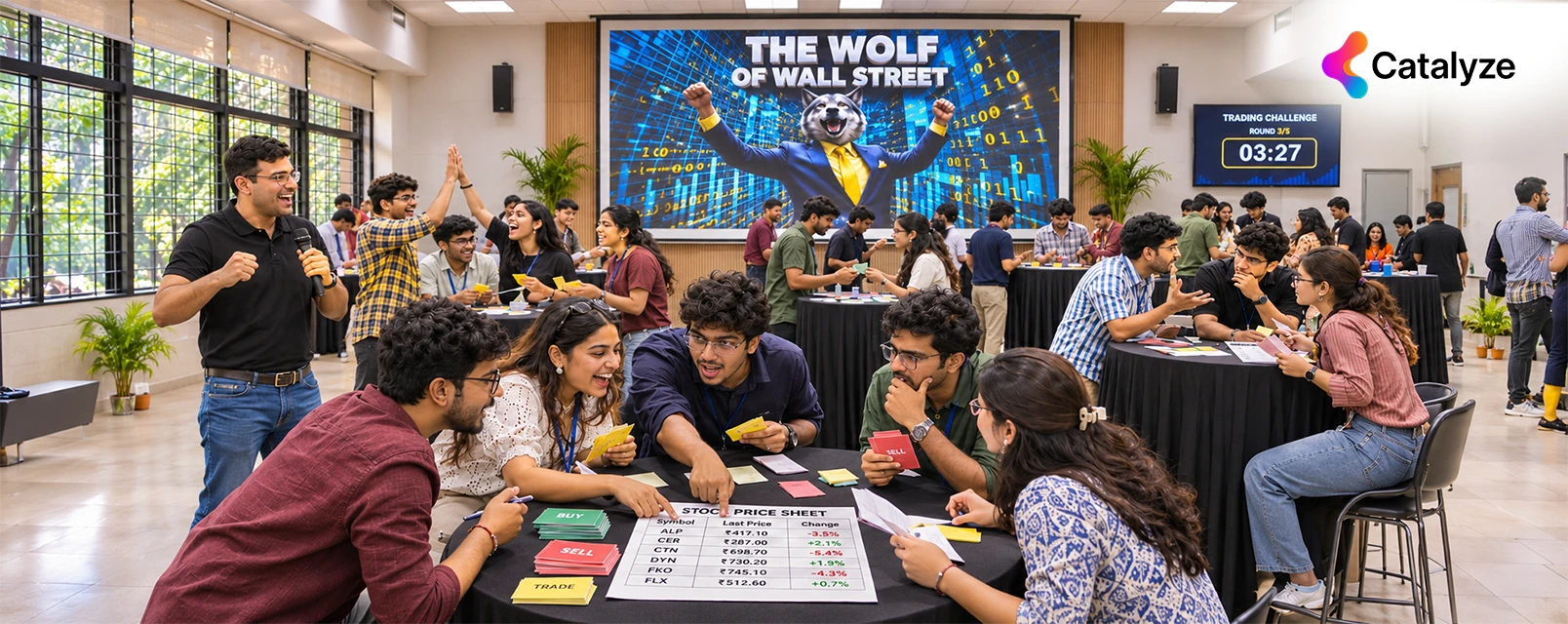
Your students can introduce themselves to a stranger in ten seconds. Ask five of them to agree on one decision in ten minutes, and the room goes quiet, or loud, or both.
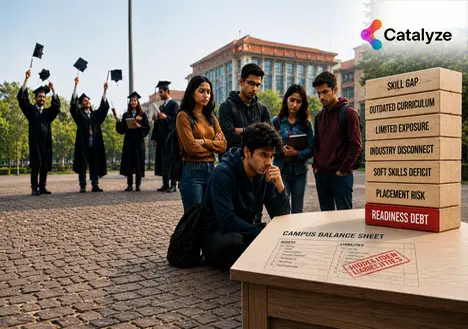
Orientation week brings name games. Three years later, the same students walk into a placement group discussion and get judged on the one thing nobody trained them for: how they work in a group when it counts.
A campus team building program is meant to close that gap. Many fall short because they stop at the warm-up. Here are four research-informed activities, what each reveals about your students, and what changes when you run them properly.
Why icebreakers stop at hello
Icebreakers get people talking. But talking is not teamwork, and recruiters are measuring something else. NACE's Job Outlook 2026 Spring Update found employers want résumé evidence of teamwork, problem-solving, and communication. In its Job Outlook 2026 survey, 70% of employers said they use skills-based hiring, up from 65% a year earlier. These are US numbers, but Indian recruiters test the same skills in GDs and group rounds.
Closer home, the India Skills Report 2026 estimates employability at 56.35% among assessed candidates, which leaves a wide gap for colleges to close. Icebreaker games for college students don't fix that, and they were never designed to. Nobody fails an icebreaker. Nobody has to compromise, hold a deadline or own a mistake, and those are exactly the moments placement panels watch.
The four team building activities for college students below work differently. Each adds pressure and makes real group behaviour visible. Run in order, they move from building together, to deciding together, to performing against a clock, to living with consequences.
1. The Marshmallow Challenge, where planning meets reality
What it is.
Teams get 20 sticks of dry spaghetti, a yard of tape, a yard of string and one marshmallow. They have 18 minutes to build the tallest free-standing tower with the marshmallow on top.
The expert backing.
Designer Peter Skillman first ran the challenge with four-person teams at Stanford, the University of California, and the University of Tokyo. Autodesk Fellow Tom Wujec later ran it with thousands of people and presented the findings at TED, and Stanford's d.school uses it in its teaching. In his trials, kindergarten teams often outbuilt business school teams by building and testing early instead of betting on a single plan. Adult teams, as author Daniel Coyle describes in The Culture Code, work out who is in charge, commit to one plan and watch it collapse in the final minute. The lesson is about method, not age.
What it shows on your campus.
The student who plans for most of the clock. The one who never touches the spaghetti. The group that saves the marshmallow for the end and loses everything. Students learn to test ideas early, share roles without a title, and treat failure as information.
How Catalyze runs it.
The Silent Build pushes the idea further: a construction task completed without speaking, using only gestures, signals, and eye contact. It runs in 45 to 60 minutes for 15 to 30 students.
2. Lost on the Moon, the GD before the GD
What it is.
Students imagine their spacecraft has crash-landed on the moon. They rank 15 salvaged items, from oxygen tanks to a box of matches, first alone and then as a team by consensus. Both rankings are scored against an expert key.
The expert backing.
This is the most heavily backed of the four. NASA scientists and engineers compiled the answer key. Social psychologist Jay Hall built the exercise around it, and his study with W. H. Watson in the journal Human Relations used it to test how groups decide. The Association for Psychological Science publishes it as a teaching exercise, and the Canadian Space Agency runs its own version, Survivor: Moon, as a teamwork and communication activity.
What it shows on your campus.
A placement GD without the stakes. You see who dominates, who caves to the loudest voice, and whether a correct answer from a quiet student ever makes it into the final list. Students practise disagreeing with reasons instead of volume, and the scores make the case for listening.
How Catalyze runs it.
The GD Lab runs a live group discussion followed by an immediate, structured debrief, so students see their GD habits while they are still fresh. It runs in 60 to 90 minutes for 15 to 40 students.
3. The educational escape room, teamwork against the clock
What it is.
Teams solve a chain of linked puzzles to "escape" within a fixed time, usually about an hour. The key design choice is that clues are spread across people, so nobody can finish alone.
The expert backing.
A systematic review by Utrecht University researchers, published in Educational Research Review, covered 39 studies on escape rooms in education, 31 of them in higher education. Teamwork and communication were the most common skill goals, and educators and students in those studies reported that the format promoted both, though most of that evidence comes from observation and self-report. Ball State University's career centre also uses one to teach workplace problem-solving.
What it shows on your campus.
Some students hoard clues. Some freeze. Some quietly organise the room. An assessment-centre round or case interview brings out the same traits. Composure, clean handovers of information and the habit of asking "what does everyone know?" before guessing.
How Catalyze runs it.
Command Centre builds the same pressure through a scenario that escalates in real time, as new information arrives and priorities shift. It runs in 90 to 120 minutes for 20 to 50 students.
4. The trading simulation, where decisions carry consequences
What it is.
Teams run a mini economy, buying, selling and negotiating resources across rounds while the facilitator introduces market shocks. Every decision shapes the next round's score.
The expert backing.
Harvard Law School's Program on Negotiation maintains more than 200 role-play simulations that educators use to teach negotiation and shared decision-making. Separately, a systematic review of empirical research on business simulation games in higher education, by Faisal and colleagues, reported gains in knowledge, cognitive and interactive skills, and behaviour, though results varied by simulation and assessment method.
What it shows on your campus.
Who negotiates and who simply agrees. Which teams blame one member when a round goes badly. Who reads the room before closing a deal.
The outcome.
Negotiation, accountability, and decisions made with incomplete information. TeamLease EdTech's Career Outlook Report for January to June 2026 lists communication, learning agility and problem framing among the top soft skills employers expect from freshers. A well-run simulation puts all three to work in a single afternoon.
How Catalyze runs it.
Wolf of Wall Street puts students into buyer and seller roles in a simulated stock market. It builds negotiation, decision-making, and financial awareness in 90 to 120 minutes for batches of around 100.
The part that turns a game into training
Here is the uncomfortable truth. Run any of these four without a structured debrief, and they slide back into the category of icebreaker games for college students: enjoyable, forgettable, and no closer to placement-ready.
The debrief is where behaviour gets named. A meta-analysis by Scott Tannenbaum and Christopher Cerasoli in the journal Human Factors found that properly conducted debriefs clearly improve both team and individual performance. A quick "so, what did you learn?" doesn't count. A facilitator describes what they observed, students reflect actively, and the conversation ends with something they will do differently.
Skip it, and you have a fun afternoon rather than a campus team building program that changes behaviour. This is where many team building events for college students fall short. The photos go up, and nothing connects back to the GD room or the project team.
Planning for your next batch? Share your batch size and placement dates with Catalyze and the team will come back with a recommended format for your batch.
Why running it in-house is harder than it looks
On paper, all four activities are simple. The hard part is everything around them.
- Students behave differently in front of their own faculty. Few will openly struggle before the professor who grades them. An outside facilitator can observe behaviour that rarely surfaces in a classroom.
- Debriefing is a skill. Naming behaviour without blame, then linking it to GDs and interviews, takes practice. Done badly, it becomes a lecture.
- Scale changes everything. Thirty students is manageable. A batch of 300 in one afternoon needs trained facilitators and tight logistics.
- Your placement cell is already stretched. Between recruiter calls and drives, designing sessions is one job too many.
How to sequence it across the academic year
For Deans, TPOs and student activity heads, the practical question is timing. A one-off day rarely changes behaviour. A campus team building program planned across the year can.
- First year: the Marshmallow Challenge at orientation, so new batches learn to work with strangers.
- Second and third year: escape rooms for project teams, student councils and fest committees.
- Pre-placement: Lost on the Moon and the trading simulation, four to six weeks before recruiters arrive.
This structure also fits national guidance. UGC's Life Skills (Jeevan Kaushal) 2.0 curriculum recommends role-play, group activities, case studies and observation for undergraduates, and its Deeksharambh guide to student induction calls for small-group activities rather than a brief orientation.
Facilitator notes, peer feedback and a repeat round show how behaviour shifts within a session. Apply the same criteria in later group projects and mock GDs to see whether it lasts. That is how team building activities for college students stop being a calendar item and start feeding into placement readiness.
If placements are already running on your campus, the next windows are close: internship drives and your next intake's orientation. Each needs four to six weeks of planning, so the conversation starts now.
Where Catalyze fits in
Catalyze designs and runs team building events for college students around one idea: the activity reveals the behaviour, and the debrief changes it.
Every session follows five steps. Students take on a challenge that needs more than one person. Facilitators observe how they communicate and participate under pressure. The debrief names what happened. The group translates those patterns to group projects and GDs. Then they apply it, repeating the challenge with a new approach so improvement is visible in the same room.
What this means for your institution:
- Scale that fits campus reality, from groups of 15 to batches of up to 400 students
- Activities mapped to the soft skills recruiters test: communication, collaboration, adaptability, critical thinking and conflict resolution
- Facilitators who have worked with real student groups on campuses, so your faculty stay free to teach
Dr. Ashok K Chitkara, Director of Chitkara University, credits Catalyze with building students' confidence and essential workplace skills.
From fun day to placement-ready
Icebreakers get students talking. These four activities show how they actually work together and give them a chance to improve before a recruiter is watching.
If your current calendar runs on fest-style games and a motivational talk, the answer isn't more events. It's a campus team building program with observation, debrief, and repetition built in.
Tell Catalyze your batch size, your programme, and your placement dates, and the team will come back with a recommended format for your institution. Book a consultation with Catalyze.