How Colleges Can Improve Placement Rates Without Adding More Technical Training

Written by Catalyze
28/10/2026
The placement numbers come in lower than last year. The committee meets. Someone says it, and everyone nods.
"Let's add another certification course."
It is the easiest decision in the room. It looks good in a brochure, it is simple to schedule, and nobody argues with more technical training.
But here is the question that rarely gets asked. Were your students actually rejected for lack of technical skill? Because if they were not, another course will not move the number. If you want to improve college placement rates, the first step is finding out where students are really being lost.
Start With the Good News. The Jobs Exist
Before blaming the market, look at what employers are saying.
TeamLease EdTech's Career Outlook Report HY2 2026, based on a survey of 1,097 companies between May and July 2026, found that 75% of employers intend to hire freshers in the second half of the year. That is up from 73% in the first half.
So demand is there. Retail, e-commerce, manufacturing and FMCG all reported fresher hiring intent above 85%.
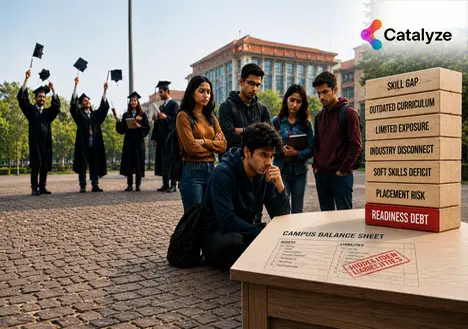
If students are still not converting, the gap is less likely to be the job market and more likely to be what happens between the shortlist and the offer. That is exactly where a lot of placement training for colleges is thinnest.
Find Out Where Students Are Actually Dropping
Ask your placement cell one simple question. At which stage did our students fall out last season?
Not "how many were placed". Where were the rest rejected?
- At the online test? Then technical and aptitude preparation may genuinely need work.
- At the group discussion? That is about listening, structuring a point, and handling disagreement.
- At the interview? That is about explaining your own work clearly, under pressure, to a stranger.
- After an offer, in the first few months? That is about workplace behaviour, not knowledge.
On many campuses, this data is rarely collected round by round. Without it, the default answer tends to be "more technical training", because that is the only lever anyone can see.
Picture a single drive. Two hundred students sit the online test and 120 clear it. Thirty get offers. The test was not the problem. Ninety students cleared the technical bar and still walked away with nothing, and no certification course would have changed that.
Once you know the stage, you know the fix. And if rejections cluster at the GD and interview, then the fastest way to improve college placement rates is not another coding bootcamp. It is employability skills development aimed at the rounds where students are falling.
Look at What Employers Ask For Alongside Technical Skills
Employers are not hiding their wish list.
In TeamLease EdTech's Career Outlook Report HY1 2026, which surveyed 1,051 employers, the top soft skills sought in freshers were communication, learning agility, problem framing, time management and digital fluency. They appear right beside the domain skills, not below them.
Read that list again as a placement officer. Communication. Learning agility. Problem framing. None of these come from an extra technical certificate.
This is where soft skills training for students stops being a "nice to have" session and becomes part of placement strategy. Employability skills development has to cover both columns of the employer's list, not just the one that is easiest to teach.
Why the Easy Fix Keeps Winning
Here is the uncomfortable part.
Technical training is easy to buy, easy to schedule and easy to report. A certificate is visible. A completion rate fits neatly into an annual report.
Communication, confidence and judgement are harder to measure. So on many campuses they get one guest lecture in the final semester, a session on "body language" and a few tips on dressing for interviews. Students sit through it, nod, and walk into the same interview room unchanged.
That is not a lack of intent. It is a measurement problem. And it shapes which campus placement preparation strategies get funded and which get squeezed into the last two weeks.
The result is predictable. Students arrive at the interview technically prepared and practically untested. Effective soft skills training for students needs the same seriousness technical training already gets: a plan, repetition and a way to track progress.
What Actually Moves the Number
You do not need a new department or a bigger budget. You need to change where the effort goes.
Here are campus placement preparation strategies that target the stages where students are lost, without adding a single new technical course.
1. Track rejections by round.
Make it a standing part of the placement report. Every drive, record where students exited. Patterns usually show up within a season.
2. Start in the second year, not the final semester.
Speaking, structuring an argument, and handling feedback are habits. Habits take time. A final-year crash course is too late to change them.
3. Turn existing projects into interview stories.
Students already have internships and projects. What they lack is the ability to explain them. Ask every student to describe one project in two minutes: what they did, what went wrong, and what they learned.
4. Practise live rounds with real feedback.
Mock GDs and interviews help when they include coaching and a second attempt, not just a score.
5. Ask recruiters what they saw.
After each drive, request two lines of feedback from the panel. It costs nothing and tells you exactly what to fix.
None of this replaces technical training. It makes sure technical training is not wasted on students who cannot show what they know. That is how you improve college placement rates with the resources you already have.
Where Catalyze Fits
Catalyze works with institutions on the part of placement readiness that technical training does not reach.
Instead of lectures, Catalyze uses experiential learning, mock interviews, workplace simulations, role plays, and business scenarios, with coaching and live feedback. Students build communication, adaptability, critical thinking, and collaboration by practising them in the same situations recruiters use to assess them.
What sets this apart from typical placement training for colleges is how it is built around the institution.
- Designed around your goals. Catalyze starts by understanding what the institution wants to improve, whether that is placements, interview readiness, or recruiter confidence.
- Measured, not assumed. Career-readiness assessments and progress reports show how students are developing, giving your placement team something concrete to track.
- Fits your calendar. From a one-day workshop to a semester-long programme or a year-long partnership.
More Training Is Not Always the Answer
The next time placement numbers dip, the reflex will be to add another course. Before you do, look at where students were actually rejected and what employers actually asked for.
If the gap sits in communication, confidence, and judgement, then the way to improve college placement rates is to train exactly that.
If you want to build that into your placement plan, book a consultation with Catalyze.