What a Career Readiness Program for Final Year Students Should Cover Before Placement Season

Written by Catalyze
18/09/2026
Every placement season follows the same pattern. Resumes get polished, mock interviews get scheduled, and students walk in hoping their degree does the talking. Then the interviewer asks something unscripted, and the silence gives everything away. A good career readiness program for final year students isn't built around a checklist. It's built around what actually gets tested the moment a real interview panel starts asking real questions.
Why Placement Season Exposes the Real Gap
Colleges teach subjects. They rarely teach the behaviours that decide who gets hired: how someone thinks on their feet, how they carry a conversation, how they handle a question they don't immediately know the answer to.
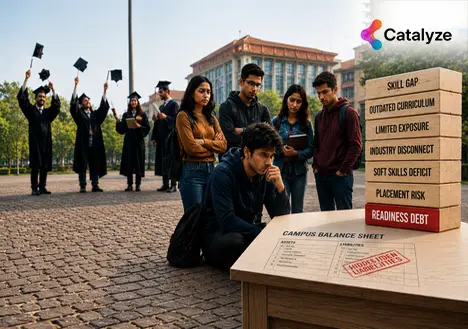
Students spend four years building technical knowledge and only a few weeks trying to build interview readiness. That imbalance is exactly what placement season is designed to expose. A student can top every semester exam and still struggle the moment a recruiter asks them to explain a project in plain language, defend a decision, or think through a scenario they haven't rehearsed. It isn't a knowledge gap. It's a readiness gap, and it only becomes visible once the stakes are real.
What a Career Readiness Program for Final Year Students Should Actually Build
The goal isn't more information. It's capability that holds up under pressure.
Communication That Doesn't Collapse Under Pressure
Clear speech, structured answers, and comfort with silence matter more than rehearsed lines. This is closer to a personality development course for students than a script-memorising drill. It's about how someone naturally shows up, not what they've been told to say. A student who can pause, think, and answer honestly usually comes across better than one reciting a memorised response that falls apart the moment the question shifts slightly.
Judgement, Not Just Certificates
Employers aren't hiring a transcript. They're hiring how someone behaves when there's no instruction manual, whether they take ownership, ask the right question, or freeze. This is harder to teach than a formula or a framework, which is exactly why it needs deliberate practice rather than a single session before placements begin.
How Employers Are Evaluating Freshers Now
Amneet Kaur Sahdra, Founder of Catalyze, has written about this shift. In her piece on rethinking entry-level hiring, she argues that many companies still screen for keywords and prior "experience" that a fresher, by definition, cannot have. Her view is that the companies getting hiring right have moved away from asking what a candidate has already done, and started asking how fast that candidate learns and how they behave when they don't know the answer. It's a useful lens for what final-year students are actually being measured against, whether their college has prepared them for it or not.
Where Professional Skills Training for College Students Fits In
This is where structured practice earns its place, not as a formality, but as repetition under realistic conditions.
A single mock interview a week before placements tests nerves, not skill. Real professional skills training for college students works in cycles: practice, feedback, correction, and practice again, so the improvement is visible well before the stakes are real. Confidence built over a semester behaves differently under pressure than confidence built the night before an interview.
This kind of training also gives students something a last-minute crash course can't: the chance to fail small, early, and privately. A student who stumbles through a group discussion in week three of training and gets specific feedback on it walks into the actual placement round having already made that mistake once, somewhere it didn't cost them anything.
Why a Personality Development Course for Students Shouldn't Stand Alone
A personality development course for students helps with posture, presence, and self-awareness, but on its own, it doesn't teach someone how to handle a panel that pushes back or a case study with no clean answer. Readiness comes from applied practice across communication, judgement, and adaptability together, not from any one module in isolation. A student can walk taller and speak more confidently after such a course and still struggle the moment a recruiter asks a follow-up question they didn't anticipate. The two need to be built together, not treated as separate boxes to tick.
Why Catalyze Takes a Different Approach
Catalyze takes a longer-term approach to student readiness than a one-off placement workshop.
Founded by Amneet Kaur Sahdra, an alumna of the Indian School of Business with 15 years of experience building teams and organisations, Catalyze works with institutions to close the exact gap this piece has been describing, through practical, ongoing skill-building rather than a single pre-placement session. The intent behind each programme is straightforward: help students communicate more clearly, handle real workplace situations with more confidence, and make a smoother transition into their first role.
The Bottom Line
Placement season doesn't test what a student knows. It tests what they can do under real conditions: communicate, decide, recover, adapt. A career readiness program for final year students that's built well doesn't try to cram all of that into the final weeks. That's the kind of readiness Catalyze is built around, and it's why institutions bring us in well before placement season starts.