The Career Readiness Gap: Why Qualified Graduates Are Still Walking Into Interviews Unprepared

Written by Catalyze
25/08/2026
Every placement season, the same scene repeats itself across Indian campuses. A student with an excellent academic record walks into an interview room, and within the first five minutes, something falls apart. Not the knowledge. Not the degree. The readiness.
At Catalyze, we have seen more than 500 candidates. And the pattern is unmistakable: qualified is not the same as ready. Students leave campus academically prepared, but interviews, internships, and first jobs reward a completely different layer, one that classrooms rarely teach.
This is the career readiness gap. And in 2025 and 2026, it stopped being anecdotal. It became measured.
What the Career Readiness Gap Actually Is
The career readiness gap is the distance between what colleges deliver and what employers expect on day one.
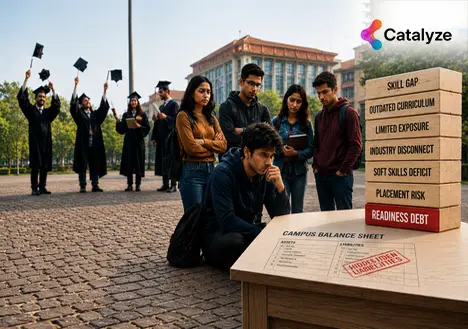
Colleges deliver knowledge, degrees, and academic performance. Employers expect communication, ownership, professional presence, and the ability to navigate a workplace with maturity. The gap between the two is where placement offers stall, internships underwhelm, and promising first jobs end in quiet exits before the 90-day mark.
What makes this gap dangerous is that it is invisible on paper. A resume cannot show that a candidate freezes in a group discussion, writes emails that get ignored, or has never been taught what "culture fit" actually means when a recruiter says it. The gap only reveals itself in the room, which is exactly when it is too late to fix.
The Data From 2025 and 2026: The Gap Is Measured, Not Imagined
Hiring managers have described this problem for years. Now, the research confirms what they see on campus.
India-Specific Findings
The Mercer Mettl India Graduate Skill Index 2025 found that only 42.6% of Indian graduates were employable, with the shortfall driven primarily by non-technical skill deficiencies rather than academic weakness. Read that again: it is not the degree that fails students, it is everything the degree never covered.
The Economic Survey 2023-24 reported that 51% of Indian graduates are considered not job-ready, citing a lack of vocational training and practical exposure. Half of the graduating population, holding legitimate qualifications, still unprepared for the roles those qualifications were meant to unlock.
The India Skills Report 2026 offers cautious optimism: overall employability has risen to 56.35%, a jump of nearly ten percentage points over four years. But the same report flags that soft skills and critical thinking deficits persist, which means the technical layer is improving while the human layer stays stuck.
The Deloitte India Campus Workforce Trends 2025 Report adds the employer side of the equation: one in three organisations believe their employees have a limited understanding of the skills required for career growth. The confusion does not end at hiring. It follows graduates into their first jobs.
The Global Confirmation
This is not just an Indian phenomenon. The Cengage Group 2025 Graduate Employability Report found that 76% of employers are hiring the same or fewer entry-level workers, up from 69% the previous year, making it the most constrained entry-level market in five years. The same report found that graduates rate personal referrals, internships, and interview skills as more decisive in securing employment than the degree itself.
Meanwhile, NACE research published in 2025 revealed a perception gap of nearly 30% between how proficient new graduates believe they are in leadership and professionalism, and how proficient employers actually find them. Students think they are ready. Employers disagree. Nobody has told the students.
Why Degrees Alone No Longer Guarantee Jobs
The Curriculum Was Never Designed for the Interview Room
Academic programmes are built to assess knowledge retention and analytical ability. They are not built to teach a student how to introduce themselves with presence, how to handle a stress question, or how to write a follow-up email that a recruiter actually reads. These are trainable capabilities, but nobody owns them in the traditional education structure. Faculty assume placement cells will handle it. Placement cells assume students will pick it up. Students assume the degree is the preparation. Everyone assumes. Nobody trains.
Employers Have Raised the Bar on the Human Layer
As AI and automation absorb routine technical work, what remains valuable is precisely what machines cannot replicate: energy, presence, judgement, and communication. Recruiters now filter for these qualities in the first five minutes of an interview, often before a single technical question is asked. A graduate competing on knowledge alone is competing in the wrong contest.
The First 90 Days Decide More Than the First Interview
Even graduates who clear interviews stumble in the transition. The unwritten rules of an office, the discipline of ownership, the difference between participating in a team and performing in one: none of this appears in any syllabus. Organisations increasingly report that early attrition and slow ramp-up among fresh hires trace back to readiness, not capability.
How Catalyze Closes the Gap
We built Catalyze around one conviction: the readiness layer can be taught, measured, and certified before the first job begins.
We do not run coding bootcamps. We do not deliver generic, one-size soft-skills lectures. We own a specific lane: the human, professional, and behavioural capabilities students need before interviews, internships, placements, and their first jobs.
Readiness Made Measurable
Institutions do not need another motivational session. They need diagnostics, scorecards, and evidence that readiness improved. That is why every Catalyze programme is built around measurement, so placement heads can show outcomes, not just attendance.
The Bottom Line
The 2025 and 2026 data settles the debate. Between Mercer Mettl's 42.6% employability figure, the Economic Survey's 51% not-job-ready finding, and the India Skills Report 2026 confirming that soft skills deficits persist even as overall employability rises, the message to institutions is clear: the degree opens the door, but readiness is what walks through it.
The institutions that act on this will not just improve placement statistics. They will send graduates into the workforce who are not just academically qualified, but professionally prepared.